
Titanium Dioxide (TiO₂): The Indispensable White Pigment of Industrial Chemistry – Applications and Advantages
In the world of industrial chemistry, Titanium Dioxide (TiO₂), one of the rare substances that combine aesthetics and functionality, plays a critical role in many areas of modern life. Thanks to its high whiteness, superior opacity, and exceptional UV resistance, it is an indispensable component in a wide range of products, from paints to plastics, cosmetic products to food additives. In this comprehensive guide, we will meticulously examine every aspect of Titanium Dioxide, from its chemical structure to production processes, basic forms to broad application areas, and the advantages it offers.
What is Titanium Dioxide? Chemical Structure and Properties
Titanium Dioxide, with the chemical formula TiO₂, is a naturally occurring titanium oxide. It is typically found as a white, odorless, and water-insoluble solid. This compound, with CAS number 13463-67-7, possesses the ability to perfectly reflect and scatter light due to its high refractive index (approximately 2.5-2.7). This property imparts superior opacity and whiteness.
It exists in nature in three main crystalline forms:
- Rutile: The most stable and common form. It is the most preferred type in industrial applications due to its high refractive index, UV resistance, and durability.
- Anatase: Less dense and softer than rutile. It is used in special applications due to its high photocatalytic activity.
- Brookite: A rare form, with less commercial importance compared to the other two.
The molecular structure of Titanium Dioxide consists of a lattice structure formed by a titanium atom covalently bonded to two oxygen atoms. This structure ensures the material's chemical inertness and thermal stability.
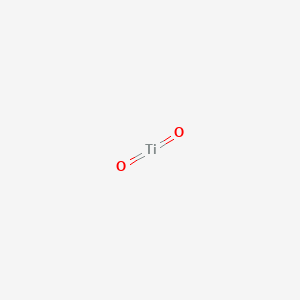
Image: Titanium Dioxide (TiO₂) 2D Molecular Structure
Production Methods: Sulfate and Chloride Processes
Commercial Titanium Dioxide production is primarily carried out by two methods:
- Sulfate Process: Titanium sulfate is obtained from ilmenite ore (FeTiO₃) using sulfuric acid, followed by hydrolysis and calcination to produce TiO₂. This method, while older and more common, may involve greater challenges in waste management.
- Chloride Process: Rutile ore or high-titanium slags are reacted with chlorine gas to obtain titanium tetrachloride (TiCl₄). TiCl₄ is then oxidized with oxygen to recover TiO₂ and chlorine gas. This method is more modern, environmentally friendly, and preferred for producing high-purity rutile TiO₂.
Basic Forms of Titanium Dioxide: Differences Between Rutile and Anatase
The two main crystalline forms of Titanium Dioxide, rutile and anatase, possess different physical and chemical properties, which leads to their preference in different application areas.
Rutile Titanium Dioxide
- Crystal Structure: Tetragonal, denser, and more stable.
- Refractive Index: High (approximately 2.7), which imparts superior opacity and whiteness.
- UV Resistance: Exhibits high resistance to color fading and degradation due to excellent UV absorption and photostability.
- Durability: Highly resistant to weathering, chemicals, and abrasion.
- Applications: Widely used in areas requiring long life and durability, such as paints, coatings, plastics, paper, inks, and outdoor applications.
Anatase Titanium Dioxide
- Crystal Structure: Tetragonal, less dense and softer than rutile.
- Refractive Index: Slightly lower than rutile (approximately 2.5).
- Photocatalytic Activity: Has a higher ability to decompose organic substances under sunlight or UV light. This property makes it ideal for self-cleaning surfaces and air/water purification applications.
- Applications: Interior paints (requiring less UV resistance), ceramics, cosmetic products (sunscreens), photocatalytic coatings, and some specialized plastic applications.
Technical Properties and Advantages of Titanium Dioxide
A series of unique technical properties and advantages make Titanium Dioxide so valuable for industrial applications:
1. High Refractive Index, Opacity, and Whiteness
The most well-known property of TiO₂ is its excellent ability to scatter and reflect light. This imparts high opacity and brilliant whiteness to the materials it is applied to. Consequently, better coverage is achieved with less pigment, which provides cost-effectiveness.
2. Superior UV Absorption and Photostability
Especially the rutile form effectively absorbs and disperses ultraviolet (UV) rays. This property prevents paints, plastics, and other materials from fading, cracking, and degrading when exposed to sunlight. This extends product life and preserves aesthetic appearance.
3. Chemical Inertness and Stability
Titanium Dioxide is inert to most chemical substances, meaning it does not react with them. This chemical stability makes it safe for use even in aggressive environments and increases the chemical resistance of the products it is applied to.
4. Excellent Dispersion Properties
Modern TiO₂ pigments are produced with special surface treatments to disperse easily in different matrices (water-based, solvent-based, polymers). This ensures homogeneous dispersion, optimizing the performance and appearance of the final product.
5. Toxicological Profile and Safety
Titanium Dioxide is generally considered a safe substance. It is used in food and cosmetic applications in accordance with specific purity and particle size standards. However, appropriate occupational safety measures should be taken as it may pose potential risks if inhaled in powder form.
Broad Application Areas of Titanium Dioxide
The unique properties of Titanium Dioxide have made it an indispensable raw material in many industrial sectors:
1. Paint and Coating Industry
Titanium Dioxide is the most widely used white pigment in the paint and coating sector. It is used in a wide range of products such as interior and exterior paints, industrial coatings, automotive paints, marine paints, and road marking paints. It provides high opacity, brightness, UV resistance, and weather resistance.
2. Plastic and Polymer Industry
It is used as a color additive and UV stabilizer in polymer materials such as PVC, polyethylene (PE), polypropylene (PP), engineering plastics, and elastomers. It imparts whiteness and opacity to plastic products and extends product life by preventing degradation caused by sunlight.
3. Building and Construction Materials
It is used in white concrete, mortar, plaster, cement-based products, and prefabricated elements to provide aesthetic whiteness and opacity. It is particularly preferred in white cement production and architectural concrete applications. Furthermore, its UV resistance helps exterior coatings maintain their original appearance for a long time.
4. Cosmetics and Personal Care Products
It is used as a physical UV filter in sunscreens and as an opacifying and whitening pigment in makeup products (foundations, powders). It forms a protective barrier on the skin, reflecting harmful UV rays.
5. Food Industry (E171)
Known by the code E171 as a food additive, Titanium Dioxide is used as a whitening and opacifying agent in confectionery, chewing gums, baked goods, and pharmaceutical coatings. However, its use as a food additive in the European Union (EU) has been restricted since 2022. Therefore, it is important to pay attention to current regulations in food applications.
6. Paper Industry
It is used in paper and cardboard production to provide whiteness, brightness, and opacity. It is particularly important in thin papers to prevent ink bleed-through and improve print quality.
7. Ceramic Industry
It is used as an opacifying and whitening agent in ceramic glazes, enamels, and glass production. Its high-temperature resistance improves the aesthetic and functional properties of ceramic products.
8. Photocatalytic Applications
The high photocatalytic activity of the anatase form is used in air and water purification systems, self-cleaning surfaces (e.g., glass, tiles), and odor-removing coatings. It contributes to environmental improvement by decomposing organic pollutants under UV light.
Titanium Dioxide Products at Ekvator Kimya
At Ekvator Kimya, we offer high-quality Titanium Dioxide products tailored to your industrial needs. Our extensive product range includes rutile and anatase forms optimized for various application areas. Our products are carefully selected to ensure superior performance and reliability.
- TITANIUM DIOXIDE BLR-699: High-performance rutile type TiO₂, offering superior whiteness and UV resistance, especially in paint, coating, and plastic applications.
- TITANIUM DIOXIDE KRONOS 2190: This rutile pigment, produced with Kronos quality, is an excellent choice for general industrial applications.
- TITANIUM DIOXIDE RUTILE R838: Rutile type TiO₂, distinguished by high opacity and dispersion properties, ideal for various coating and plastic formulations.
- TITANIUM DIOXIDE R-868: Rutile pigment specifically designed for outdoor applications requiring high durability and weather resistance.
You can contact our expert team to get more information about our products and find the most suitable solution for your needs.
Sustainability and Future Perspectives
The production and use of Titanium Dioxide are continuously evolving to minimize environmental impacts and adhere to sustainability principles. Efforts are ongoing in production processes regarding energy efficiency, waste reduction, and recycling technologies. Furthermore, its photocatalytic properties, which improve air and water quality, further strengthen TiO₂'s future environmental role.
Conclusion
Titanium Dioxide (TiO₂) continues to be one of the cornerstones of modern industry. With its high whiteness, superior opacity, UV resistance, and chemical stability, it adds value to countless products. As Ekvator Kimya, we are proud to support our business partners in the construction, paint, plastic, and other sectors by providing the highest quality Titanium Dioxide products, helping them achieve their aesthetic and performance goals in their projects. We are always here for customized solutions and technical support.
For more information and product details: Ekvator Kimya Products Page